In this story
- The short version
- What a safari day looks like
- The Big Five, and why not to plan around them
- Choosing where to go
- The Great Migration, month by month
- When to go: dry season or green season
- National parks and private conservancies
- How long, and how many camps
- What to pack
- Health, visas and the unglamorous bits
- Etiquette, ethics and tipping
- Mistakes worth avoiding
- Four ways to begin
- What it costs
- Safari words, explained
- If you are traveling with a group
- Where I would start
The word safari is Swahili, and in Swahili it simply means journey. Any journey: a bus ride, a ferry crossing, a trip to see a relative. It comes from the Arabic safar, meaning travel, and it entered English in the late 1850s through the explorer Richard Francis Burton. Somewhere along the way the word picked up khaki, binoculars, and a particular sunrise, but it never lost its first meaning. A safari is a journey, and a good one is shaped long before you land.
This guide is long on purpose. A safari is one of the most expensive trips most people will ever take, and much of what goes wrong on one goes wrong at the planning stage: the wrong season, too many camps, the wrong idea of what you are going to see. So I have tried to put in everything I would want a friend to know before booking. It covers how a day actually works, how to choose a place, how the migration really moves, what to pack, what to ask, and the mistakes worth avoiding. At the end are four sample trips and a short section on traveling with a group.
The short version
| Place | Known for | Go when |
|---|---|---|
| Serengeti, Tanzania | The Great Migration, huge open plains, big cats | January to March for calving, June to September for rivers and the north |
| Maasai Mara, Kenya | Mara River crossings, private conservancies | July to October for the herds, quieter in October and November |
| Ngorongoro Crater, Tanzania | A natural amphitheater packed with wildlife | Year-round, with the dry months easiest |
| Okavango Delta, Botswana | Water, islands, boats and walking | June to August, when the flood peaks in the dry winter |
| Sabi Sand, South Africa | Private reserves, close sightings, an easy first trip | The dry southern winter, roughly May to September |
Before the maps and the months, it helps to know what you are actually signing up for. A safari day is not what most people imagine.
What a safari day looks like
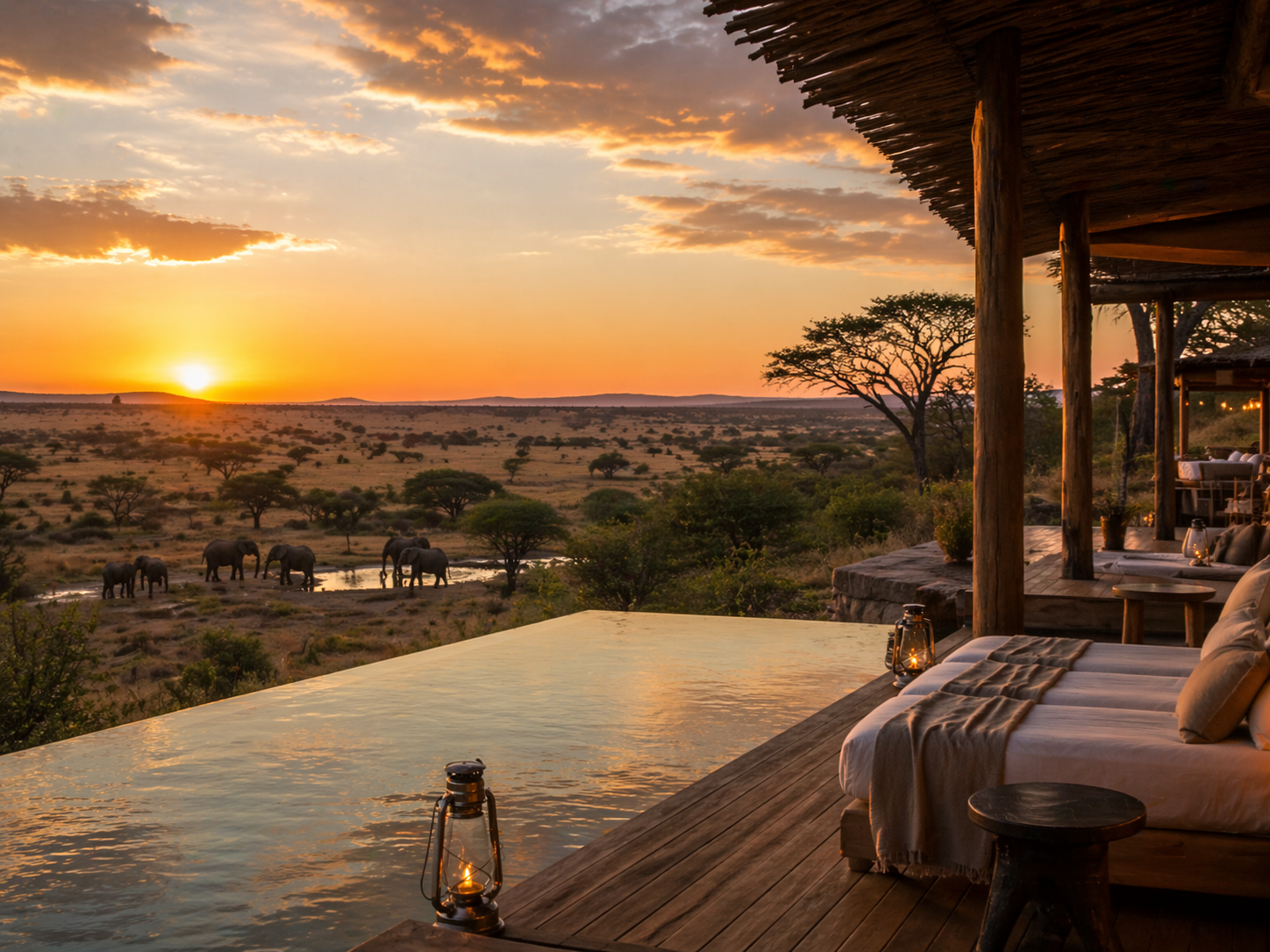
It starts in the dark. A knock at the tent, a tray of coffee, and you are in an open vehicle before sunrise, wrapped in a blanket, because animals are most active in the cool of the early day. The pattern has hardly changed in nearly two centuries. In 1836 an expedition led by William Cornwallis Harris set the daily rhythm still used today: an early start, a long morning, a rest in the heat of the afternoon, then an evening out and dinner with stories.
Coffee, then out in an open vehicle with a guide, and often a tracker. Big cats are often still active at first light, and the air is cool. Expect to be back in camp for a late breakfast.
The animals rest, and so do you. Lunch, a swim, a book, a nap. The best camps make this the quiet center of the day, not a gap in it.
The light turns gold and the animals return to the move. Many drives stop at a good spot for a sundowner, a drink as the sun sets.
Dinner is often outdoors, around a fire. In some private areas a night drive is possible, to look for nocturnal animals that you will not see by day.
One more thing about the day. A safari is not a theme park. There are long stretches of nothing, and then ten seconds of everything. A good guide is the person who knows how to make the nothing interesting, by reading tracks, bird calls, and the behavior of other animals. A great safari is almost always remembered for its guide.
The Big Five, and why not to plan around them
The Big Five are the lion, leopard, elephant, Cape buffalo, and rhinoceros. The phrase began as hunters’ shorthand for the five animals considered most dangerous to pursue on foot, and it survived as a checklist for photographers. It is a fun game, and you should play it, but it is a bad way to choose a destination. Plan around the experience you want, and the Big Five will mostly take care of themselves.
Lives in prides and is the dominant large predator in most of the places in this guide. The Serengeti and Maasai Mara ecosystem is thought to hold more than 3,000 of them.
Hard to see, often resting in a tree. Seeing one is a matter of a good guide and some patience, and it is the sighting guests talk about longest.
Moves in family groups, usually led by an older female. A herd at a waterhole, quietly drinking, is one of the best sights on any safari.
Seen in large herds, often near water. Respected by guides for good reason, and a reminder that these animals are wild.
The hardest to find. The Serengeti has fewer than seventy eastern black rhinos, and Ngorongoro’s population has been rebuilding, from 13 animals in 1993 to 55 in 2018.
So where should you actually go? Here are five places, each good at something different.
Choosing where to go
The Serengeti, Tanzania
Almost 15,000 square kilometers of grass, kopjes, and sky, protected since the mid-twentieth century and a World Heritage Site since 1981. It is home to more than 1.5 million wildebeest and about 250,000 zebra in the migration, along with large numbers of lions, hyenas, and buffalo. The park is large, and the experience changes dramatically depending on which part you visit and which month you come. If you want one place to experience the full scale of East Africa, this is it.
The Maasai Mara, Kenya
The Mara is smaller, about 1,510 square kilometers, and it connects directly to the Serengeti. It was set up in 1961 and named for the Maasai, and its name comes from a Maa word meaning spotted, for the trees dotting the landscape. It is famous for the Mara River crossings between July and October, when herds cross in front of crocodiles and lions. Around the reserve are private conservancies, which I describe below, and they are why the Mara can feel remote even when it is busy.
Ngorongoro, Tanzania
A collapsed volcano, with a crater floor of about 260 square kilometers and walls rising about 610 meters. The crater is a closed arena, so wildlife is dense, and the lion population is one of the densest known. It has been a World Heritage Site since 1979, and it is protected by a cap of 50 vehicles in the crater at any one time. It is also a place where Maasai communities live, and nearby Olduvai Gorge, about 50 kilometers long, is a key site in the story of early humans. Most people visit for a day or a night on the way to the Serengeti.
The Okavango Delta, Botswana
This is the one place on the list that works like nothing else. The Okavango is an inland delta, where a river spreads across the desert and never reaches the sea. The water arrives from rain on the Angolan highlands in January and February, takes about a month to travel roughly 1,200 kilometers, and floods the delta between March and June. The flood peaks from June to August, in the middle of Botswana’s dry winter, when the delta grows to roughly three times its permanent size. That is why this is the best time to visit, because the land is dry and the water is full of life. It became a World Heritage Site in 2014, the 1,000th on the list. Visit by boat, on foot, or by traditional canoe, and expect a quieter, slower safari. Moremi Game Reserve is on its eastern side.
Sabi Sand, South Africa
A private reserve established in 1948 and sharing a 50-kilometer unfenced boundary with Kruger National Park, so animals move freely between them. The reserve is a group of privately owned properties, and its lodges include names like Londolozi, Singita, Sabi Sabi, and Lion Sands. Private reserves usually allow vehicles to leave the track to follow an animal, which means closer sightings than most national parks. It is also the easiest safari to combine with a city stay in Cape Town or a wine trip, which makes it a good first one.
The Great Migration, month by month
This is the part most people have seen on television and understand least. The migration is not an event in one place. It is a circle, a slow loop of more than a million wildebeest and hundreds of thousands of zebra following the rain across the Serengeti and the Mara. It has no beginning, and it does not happen on a fixed schedule. Use the table as a guide to the pattern, and remember that the herds follow the weather, not the calendar.
| When | Where the herds are | What you see |
|---|---|---|
| January to March | Southern Serengeti and the Ndutu area | Calving season. Hundreds of thousands of calves are born, and predators follow |
| April to May | Moving northwest through the central Serengeti | The long rains arrive, the park is green and quiet, and some southern camps close |
| June | Seronera, the Grumeti River and the western corridor | Grumeti crossings, less predictable and usually less dramatic than the Mara |
| July to September | Northern Serengeti and the Maasai Mara | The Mara River crossings, typically from late July through September |
| October | Leaving the Mara, heading south | A quieter Mara with strong resident wildlife |
| November to December | Central and eastern Serengeti plains | The herds spread across the grass, with fewer visitors |
Two honest warnings. The first is that river crossings cannot be promised. Herds may wait on a bank for days, or cross the moment they arrive, and crocodiles and lions make every crossing dangerous. A safari that depends on seeing one is a safari that depends on luck. The second is that the busiest time in the Mara, August and September, is also the most expensive, and camps near the river fill quickly. If you want to be there then, plan about a year ahead.
The calendar matters, but the more useful question is a simpler one: dry or green?
When to go: dry season or green season
Animals gather near water and the grass is shorter, so they are easier to see. The air is clear and mornings are cold. It is also the busiest and most expensive time, and the best-known camps fill early.
The land is lush, the birdlife is at its best, and young animals are everywhere. There are fewer visitors and lower rates, but roads can be rough in the heaviest rains, and some camps close then.
In southern Africa the calendar flips. Botswana and South Africa have their dry season in the southern winter, roughly May to September, and the Okavango flood arrives at the same time. So the best time for one region is not the best time for another, and a trip that combines East and southern Africa needs to be planned carefully.
National parks and private conservancies
This is one of the most useful things to understand, and almost nobody explains it. A national park or reserve is open to everyone who pays the fee. A private conservancy or reserve is land that is managed for a small number of guests. The difference shapes your whole trip.
| National park or reserve | Private conservancy or reserve | |
|---|---|---|
| Crowds | More vehicles, especially at big sightings | Strict caps on beds and on the number of vehicles at a sighting |
| Activities | Driving on set tracks, usually by day | Often night drives, walking safaris, and driving off the track |
| Cost | Lower | Higher |
| Who benefits | Park authorities | In the Mara, Maasai landowners who lease their land to the camps |
The Mara has 14 conservancies, mostly on former Maasai grazing land to the north and east of the reserve. Most have only a few lodges, and no self-driving is permitted in any of them. It is a good model, though it is not perfect, and there are reports of disputes over how profits are shared, so it is worth asking your operator which camps have good relationships with their landowners.
How long, and how many camps
This is my own rule, and I hold it firmly. Stay at least two or three nights in each camp, and do not use more than two or three camps in a trip. Moving every night feels productive and is actually tiring. Each move costs half a day, and you spend your holiday in a vehicle or on a small plane. A week of safari in two places will show you more than a week in five. Most good trips are between seven and ten nights, and they include at least one day with no activity at all.
What to pack
Khaki, olive, tan. Skip black and dark blue in areas with tsetse flies, which are drawn to them. Mornings in an open vehicle are cold, so bring a fleece and a light jacket, and a hat for the afternoon.
Small planes between camps often have tight weight limits, frequently around 15 kilograms (33 pounds), and hard suitcases do not fit in the hold. Use a soft duffel, and confirm the exact limit before you pack.
The best single thing you can bring. A good pair makes a distant leopard a real sighting. Your guide will probably have a pair, but your own is better.
Most of what you see is far away. A phone is fine, but a camera with a long lens changes what you take home. Bring spare batteries and cards, and a way to keep out dust.
High-factor sunscreen, a repellent, and a refillable bottle. Camps will supply water, so you do not need to bring bottles.
A headlamp, a small power bank, a scarf for the dust, and a good book for the long middle of the day.
Health, visas and the unglamorous bits
None of this is exciting, and all of it matters. Malaria is present in many safari areas, so speak to a travel-medicine clinic well before you go, not the week before. Yellow fever vaccination requirements depend on where you have been and where you are going, so check the entry rules for your whole route. Check your passport validity and the number of blank pages, and check whether each country needs a visa or an electronic authorization. Take travel insurance that covers medical evacuation, because many safari areas are far from hospitals. Your safari designer should handle these questions with you, and if they do not raise them, ask.
Etiquette, ethics and tipping
A few rules are universal. Stay in the vehicle unless your guide says otherwise. Keep your voice low, and never feed or call an animal. The guide decides how close to go, and that decision is part of why you hired them. Ask before photographing people.
When you choose an operator, ask who benefits. Camps in conservancies pay lease fees to landowners, and places with caps on vehicles protect the animals from pressure, as at Ngorongoro, where no more than 50 vehicles are allowed in the crater at a time. Tipping the guide, tracker, and camp staff is customary almost everywhere. Ask your operator for the usual amounts in advance, so you can bring them in the right currency.
Mistakes worth avoiding
Moving every night. Pick two or three places and stay.
A river crossing, a leopard, a lion kill. These are gifts, not promises.
Getting to a camp can take most of a day. Count those days in your plan.
A beautiful tent with an average guide is a worse safari than the reverse. Ask about the guides.
The best camps in peak months fill about a year ahead.
You will wear the same few things for a week. Bring less than you think.
Four ways to begin
These are starting points, not packages. Every safari we plan is designed around the person, the dates, and the pace.
A night or two at Ngorongoro Crater, then two Serengeti camps, placed to follow the herds for your month. The classic first safari for people who want scale.
A shorter, quieter safari in a private conservancy, with night drives and walking. Strong for a first trip, and easy from Nairobi.
Two camps in the delta in June to August, with boats, walks, and flat, quiet light. For people who want something different from the classic.
A private reserve for close sightings and comfort, then a few days in Cape Town and the winelands. The easiest safari to combine with a beach or city.
What it costs
I will not put numbers here, because they change with the season and the camp, and a number without context is misleading. What I can tell you is what moves the price. The season: peak migration months cost the most. The type of camp: a private conservancy costs more than a standard lodge. The distance between camps, because small planes are a large part of any budget. Park and conservancy fees, which are charged per person per night. And the length of stay. A safari is expensive, and it rewards you for spending it well, by choosing fewer places and the right guide.
Safari words, explained
A trip in an open vehicle to look for wildlife. Usually two a day.
A person, often on the front of the vehicle, who reads tracks and signs. A great tracker finds the leopard.
A drink during the evening drive, at sunset, in a good spot.
Private or community land managed for wildlife and a limited number of guests.
A traditional dugout canoe, used to travel quietly through the Okavango.
A rocky outcrop on the plains, often used by lions and leopards as a lookout.
If you are traveling with a group
A safari works well for a family, friends, or a small private group, especially with a private vehicle for each party. Larger groups need more planning, because camps are small, so a group may need to be split across properties, and private vehicles and guides need to be reserved early. We design group programs, and we manage the logistics from the start. You can request a proposal or start with a private trip inquiry.
Where I would start
If you have never been, choose one region and two camps, give yourself at least seven nights, and choose your month for the experience you want. If you want the migration, think about the rivers or the calves, and decide which. If you want quiet, go to the Okavango or a Mara conservancy. And ask about the guides first.
If you would like help, tell us the dates, the group, and what you hope to see. Every trip we plan is designed individually and by inquiry only.
- Keep reading: a quiet week on the Amalfi Coast, or a better way to experience New York City.
Facts about parks, dates, and migration patterns were checked against published sources. Migration movements follow the weather and cannot be guaranteed, and fees, vehicle limits, health requirements, and entry rules change, so please confirm current details before you book.
Miri